
Spatial Narratives & Scenography
Space is the medium.
Experience is the message.

The First Atlas Children's Museum
Before meaning, there was feeling.
The First Atlas is an emotional architecture of early consciousness — a spatial journey through how a child begins to know the world.
It starts in contrast: light and shadow, black and white, symmetry as order. Then it loosens — lines tilt, depth emerges, and sound, scent, and texture begin to speak. What was observed becomes touched, imagined, then made.
Here, architecture leads before language — shaping perception, movement, and memory. A museum not of objects, but of origins.
“The world for them is not a concourse of objects in space; it is a series of independent acts.”
-- Jorge Louis Borges
I didn’t know what the world was yet.
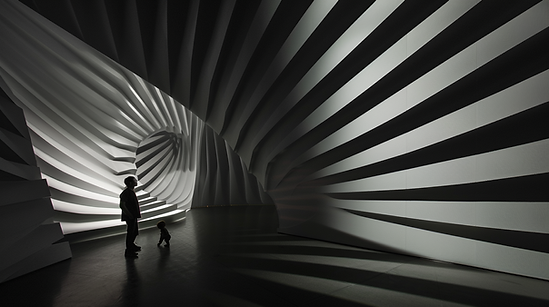
Contrast World
I didn’t know what the world was yet.
Only that something appeared,
And something disappeared.
Light cut through everything.
Walls broke into black and white.
Shadows moved before anything had a name.
I followed the difference.
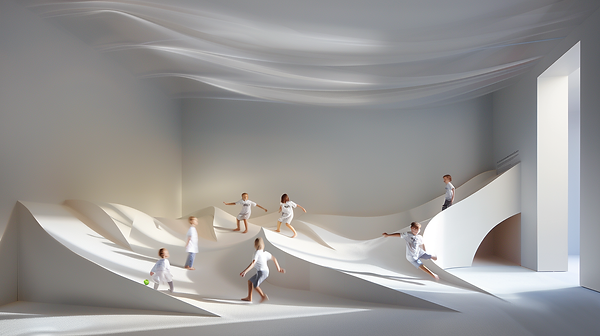
Movement Landscape
The ground stopped staying still.
It lifted me.
It dropped me.
It asked me to try again.
I climbed without knowing where I was going.
I fell without being afraid of it.
My body understood before I did.
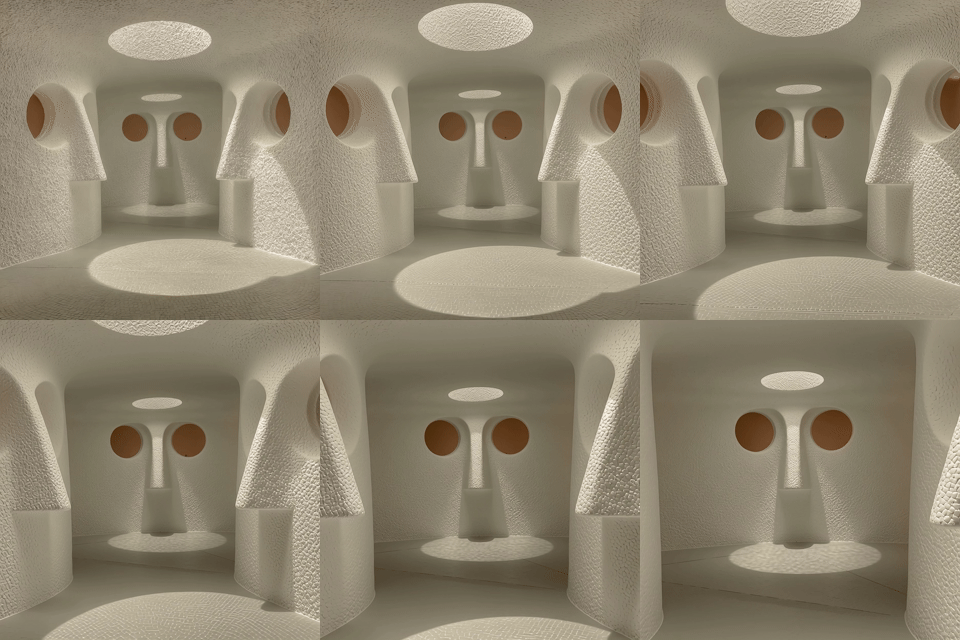
Faces & Patterns
Then something looked back at me.
Two points. A curve.
A feeling of someone.
I started seeing faces everywhere—
in walls, in openings, in light.
I didn’t know what a face was.
But I knew it mattered.

Texture Terrain
I reached out.
Some things held me.
Some things slipped away.
Some things surprised me.
The world wasn’t just something I saw anymore.
It touched me back.
Regulation Reef
Then everything became quieter.
The light softened.
The edges slowed down.
The noise moved further away.
I didn’t need to understand anything here.
I just needed to stay.


Rhythm & Echo
Then the world answered.
I made a sound—
and it returned to me.
I moved—
and something moved with me.
The space was no longer silent.
It was listening.
Loose Parts City
Nothing stayed where it was.
Things moved.
Came apart.
Came together again.
I didn’t have to follow the world anymore.
I could change it.


Imagination Theater
Then things didn’t have to be real.
Light became something else.
Shadows became someone.
Spaces turned into stories.
I wasn’t just inside anymore.
I was making what I saw.


Nature / The Open
Then everything opened.
No walls.
No edges.
No instructions.
Just air.
Light.
Space.
And somehow—
I knew how to be in it.
I didn’t know what the world was.
Until I felt it.
The First Atlas is shaped by thinkers who understood that perception comes before explanation — that we feel before we know. From Jean Piaget’s idea of a world constructed through action, to Maria Montessori’s belief in the intelligence of the senses, the project builds on the child as both observer and maker. It draws from Antonio Damasio, where emotion becomes the ground of thought, and from Juhani Pallasmaa and Peter Zumthor, where architecture is not seen, but felt. Light is not illumination but material — as explored by James Turrell and Olafur Eliasson — and play is not entertainment, but a method of understanding, as Bruno Munari once suggested. Beneath it all, a quiet echo of Jorge Luis Borges — the idea that the world is not a fixed place, but something we are constantly learning how to perceive.